

How To Set Up A Canister Filter For Freshwater
For many aquarists, upgrading to a canister filter is an exciting pace up from a hang-on-the-back power filter. External power filters are much smaller and have less-sophisticated filtration and flow control. They're easier to set up and maintain but don't take the flow rate, filter media options and accessories of a canister filter.
But similar the smaller ability filters, canister filters need to be assembled earlier utilize. Information technology tin be quite intimidating when y'all starting time open the box and see all the different components that have to be put together. Only don't allow yourself to be overwhelmed. We'll take yous pace-by-step through the basic of setting up your canister filter.
Stride 1: Read the transmission
Not everyone enjoys reading product manuals. A lot us like to jump in try to effigy things out on our ain. This can be a difficult task with an aquarium canister filter. Depending on the model, there can exist over twoscore parts that need to be fastened in the right place and in the proper order.
The manual volition help you lot recognize the private parts your going to assemble to get the canister filter up and running. The main reason for new filter problems is due to making a mistake when setting information technology upwardly the beginning time.
Step ii: Check the parts list
It'south e'er a good idea to compare the parts list with what came in the box. It's rare but an important component may be missing. Meliorate to check and make sure your new canister filter has all the parts needed before starting to ready it upwardly.
If something is missing, you have the option of exchanging the unabridged filter or contacting the manufacturer for a replacement role. At that place's zero so frustrating as having your filter generally assembled just to find an essential role is missing.
Comparing the parts list to what came in the box will too brand the assembly go quicker. Y'all'll accept an thought what the component looks similar and how many you demand for each step in the assembly.
Step iii: Assemble the canister
Open up the canister and examine the filter baskets. Notice how they nest together. If the baskets are arranged incorrectly, the lid won't seat properly. This tin can put damaging stress on the lid clamps or crusade leaks betwixt the canister the chapeau.
Have annotation of the filtration media. Some canister filters come with a full set of media, including activated carbon, sponge filters and biological filter media. If your want to use activated carbon, ammonia-removing zeolite or other specialty media, yous may have to purchase information technology separately before assembling the canister. The educational activity booklet should tell you the proper order of stacking the filter media in the baskets. The normal order from bottom to top is:
-
Filter sponges to trap droppings earlier information technology clogs the other media.
-
Activated carbon to remove organics, odors and discoloration
-
Biological filter media to help eliminate ammonia and nitrite.
-
Top filter pad or sponge
Every canister filter is slightly different. Taller canisters accept more baskets, allowing for a greater variety of media. Follow the directions that came with your brand of filter. Be certain to thoroughly rinse the filter media before placing it in the filter. Rinsing removes dust and prevents it from entering your aquarium. It also flushes air bubbles out of media like activated carbon.
Footstep iv: Place the canister filter nether your aquarium
Exam-fit where you desire to identify the canister. If it'due south going under the tank or in the cabinet, you'll want to make sure it fits and is like shooting fish in a barrel to remove for maintenance. The ability cord has to achieve a ability outlet also.
Experiment and find the best location based on where the tank is located, and the amount of room needed for maintaining the filter.
Merely there's more! Canister filters should exist placed below the aquarium. That's considering the canister fills by gravity and "feeds" the pump water. Some aquarists accept been able to place the canister filter next to the aquarium if they accept taller tanks. Merely often times the siphon action is very week, starving the pump of water and causing the filter to stop working.
Step 5: Install the hoses
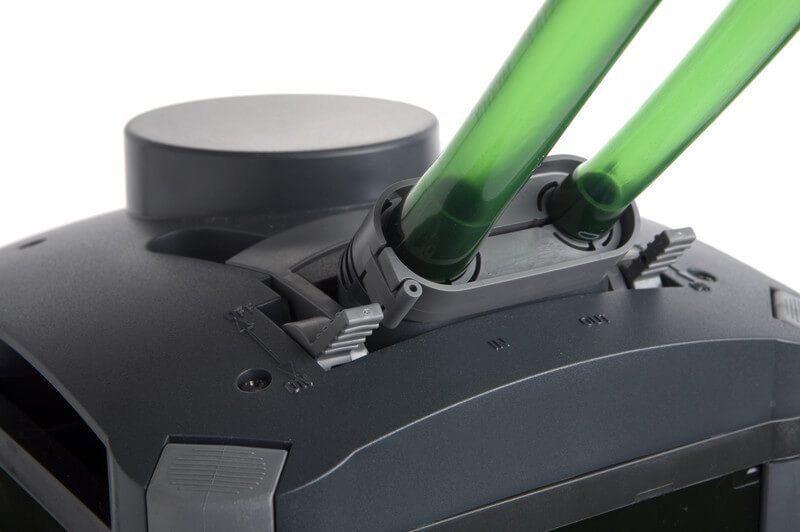
Canister filters require ii hoses. Ane directs water into the canister filter. The other hose is used to return purified water to the aquarium. Proper installation of the hoses depends on where the canister is positioned. At that place needs to be room for the hoses to connect to the top of the canister filter. Merely you'll likewise need enough room to slide the filter out of the cabinet for maintenance.
The all-time approach is to assemble the intake and return tubes and connect them to their respective hoses. Place the hoses on the aquarium in the position where they likely stay one time the filter is set up. Next, run the hoses behind the aquarium and into the cabinet. The idea is to permit enough slack in the hoses so you can slide the canister filter out of the cabinet for maintenance.
If your filter comes with quick disconnect valves you won't have to worry about this. The quick disconnects let y'all to shut off the hoses and disconnect them from the canister without pulling the canister out of the cabinet.
The master thing to call up when deciding on the length of hose is kinking. If the hose is as well long or positioned improperly it tin can droop and cause a kink or abrupt bend. This cuts off the water supply and reduces water flow. Test fit the hoses to find out the best length for your particular aquarium set-upward.
Special data almost canister filter hoses
Nosotros've compiled several "pro tips" for working with filter hoses and tubing.
The best type of tubing is made of thick-walled silicone. The combination of thick walls and flexibility prevents kinking fifty-fifty in tight bends. Silicone tubing is soft compared to other plastics. This makes it easy to push barbed inlet and outlet fittings into the hoses. Silicone tubing doesn't have a "retention." Even though it's coiled up in the filter box, it will roll out straight without any bends or kinks.
Some canister filters come with vinyl tubing. The thick-walled types resist kinking and accept very picayune retentivity. They'll sideslip easily onto inlet and outlet fittings. The cheapest budget vinyl hoses have thinner walls and aren't very flexible. When y'all try to unroll the hoses, they'll stay bent and even kinked.
Just there is a way to make working with stiff hose easier. Fill up the kitchen sink with warm water. Soak the hoses in the water until they soften up. You lot'll be able to "massage" the bends and kinks out when the tubing gets softer due to the warm water.
Once the hoses are softer it will be easier to slide barbed fittings into the hose ends. You won't take to wrestle with stiff hoses. They'll hands bend and conform while positioned under your aquarium.
Step vi: Prime the canister filter
Once the canister is loaded with filter media and the hoses are installed, you're ready to prime number the filter. Most canister filters position the water pump inside the canister hat. Plugging in the filter won't pull water into the canister. All it volition do is damage the impeller.
Here's how the typical canister filter works. The canister tank must exist completely filled with h2o earlier plugging in the filter. When the pump begins to ship the water back to the tank, water from the aquarium, past siphon activeness, refills the canister.
The render pump is pushing h2o upward and into the aquarium. That's why the intake hose is often larger than the return hose. The larger hose sends more water, by siphon activity, to the canister ensuring the pump never runs dry. But to start this process you need to prime the filter first.
Priming means filling the canister tank with h2o. Many canister filters include a priming push. It's really a small-scale internal suction pump that starts the siphon on the intake side of the filter. A few pumps of the primer and aquarium water starts filling the canister. If your filter doesn't take a primer, you'll accept to suck on the outlet hose to offset the siphon. In one case the canister is completely full of water, plug it in.
Dealing with air inside the filter
When you get-go start upwardly the filter, there'south going to exist some air trapped inside the canister.
Filter media like activated carbon and sponge filters will release air into the filter. The pump will probably make some whooshing noises every bit the air is forced out of the filter.
If the impeller makes a grinding sound, it'southward because there is an air pocket within the canister tank. The air pocket is preventing the pump from moving water and air out of the filter. Unplug the filter and look a almost thirty seconds. Plug the filter back in and the pump should run unremarkably.
Step 7: Conform the intake and screen
There are several mutual styles of intake fittings. About canisters come with a fixed length intake tube with a filter screen on the bottom. You'll besides find some canisters come with intake extension tubes, assuasive you to add to the length of the intake.
The idea is to lower the intake screen closer to the bottom of the aquarium. The logic is the lower intake will suck solid debris off the bottom of the gravel surface. Truth is, if your aquarium has visible solid waste accumulating on top of the gravel, the tank'south in big trouble. You're over-feeding or accept too many fish.
Besides, canister filters don't accept the suction power to sweep water and debris off the bottom of the tank. So, the choice is up to you lot how low you desire to get with the intake.
Most aquarists choose to place the intake lower in the aquarium. It helps to hide the intake screen. The intake screen is important considering it prevents fish from existence sucked into the filter system. Snails are notorious for finding they way into canister filters. Their hard crush will jam the pump's impeller and stop the pump. Ever apply the intake screen!
Footstep viii: Adjust the filter return tube
The return outlet may be a simple nozzle that sends water back into the aquarium. More advanced returns allow you to arrange the management of the flow to left and correct and even up or down. You'll have the option of sending the water deeper into the tank or across the surface for wave activity.
A spray bay provides a gentle h2o flow and agitates the surface of the water. Surface agitation increases the oxygen content of the aquarium h2o. Some aquarists similar the sound of spraying water while others cull to apply the quieter nozzle option.
Tips for a leak-free canister filter
The near common complaint about canister filters is related to leaks where the lid and canister tank meet. The lid uses a rubber O-ring to grade a seal between the chapeau and the canister.
In that location are several seal designs depending on the brand of canister filter. O-rings tin can be round or stretch to fit onto a square motor. Some filters have the O-ring seated into a groove on the hat.
Before assembling your filter, take a close look at the O-band to see how information technology is supposed to fit onto the canister and lid. If the O-band is not positioned correctly, it won't seal properly. If the O-band gets twisted or wedged when the hat is pressed onto the canister, you may see drips or even a stream of h2o shooting out of the seal. Immediately shut off the valves or quick-release, and re-seat the O-band.
When you cutting the hoses, brand sure the cut is smooth with no jagged edges. The cut ends of the hose should exist "square" and not on an angle. That's because you want the hose to have an fifty-fifty "grip" all the mode around the hose barb.
Some canister filters use locking pinch fittings on the canister and on shut-off valves. The compression nuts tighten on the hoses for a good seal. If the hose ends are not cutting squarely, the pinch nut wont' make a good seal. This can cause drips or the hose to accidentally pull off of the canister.
Your canister filter may come with plastic hose clamps. This type of clamp is designed to secure a hose on a barbed fitting. They're frequently used on the intake and return outlets. Hose clamps are also used to secure hoses on the canister itself. This blazon of clamp only requires manus-pressure level to tighten it around the hose and affront. Information technology'due south not necessary to use a wrench. You lot'll likely over-tighten or snap the plastic clamp.
Quieting a noisy canister filter
One of the issues some canister filter owners have is noise. Sometimes, when the canister filter is inside the aquarium chiffonier, an audible hum can be heard. This is caused by the natural vibration of the filter's electrical pump motor.
Normally it's inaudible just inside a difficult, wooden cabinet the sound gets amplified. Its as if the cabinet is like a speaker box, making the small dissonance much louder. The way to eliminate or reduce this vibration is to isolate the base of the canister from the hard cabinet. Pieces of corrugated paper-thin placed under the canister will dissipate vibrations and quiet the filter.
Closing Thoughts
Once you get to know your canister filter, you lot'll find the prepare-upwardly and maintenance quite easy. The central for success is to take your time when assembling and setting up your new filter system. The benefits of better filtration, cleaner water and water apportionment are worth it!
If y'all have any questions or comments, leave them beneath.

How To Set Up A Canister Filter For Freshwater,
Source: https://fishtankadvisor.com/canister-filter-setup/
Posted by: joneslindowlsible1974.blogspot.com
0 Response to "How To Set Up A Canister Filter For Freshwater"
Post a Comment